Research
I work on machine learning for theoretical condensed-matter physics.
A full list of publications is available on Google Scholar and in the Curriculum Vitae.
Featured Project
Reduced Density Matrices Through Machine Learning
- Principal Investigator (PI) Name: Prof. Jiabin Yu
- In Collaboration With: Prof. Jiabin Yu (supervisor), Lexu Zhao (Gavin)
- Institution and Department: Department of Physics, College of Liberal Arts and Sciences, University of Florida
- Timeline: October 2024 - present
- Research focus: n-particle reduced density matrices (n-RDMs) play a central role in understanding correlated phases of matter, but their calculation is often computationally inefficient for strongly-correlated states at large system sizes. In this work, we use neural network (NN) architectures to accelerate and even predict n-RDMs for large systems. Our underlying intuition is that, for gapped states, n-RDMs are often smooth functions over the Brillouin zone (BZ) and are therefore interpolable, allowing NNs trained on small-size systems to predict large-size ones. We devise two architectures: a self-attention NN that maps random RDMs to physical ones, and a Sinusoidal Representation Network (SIREN) that maps momentum-space coordinates directly to RDM values. Trained on small meshes, these networks provide high-quality initial guesses for Hartree-Fock (HF) at much larger system sizes, reducing the required number of iterations by up to 92% compared to random initializations. See our arXiv preprint for the full results.
- Project responsibilities: Primarily responsible for the machine learning aspects of the project, including data preprocessing and postprocessing, as well as designing, implementing, and training neural networks, and fine-tuning their hyperparameters.
- Follow-up work: Also contributed to a study led by Justin Hart, extending the method to fractional Chern insulators. It introduces representability-aware networks, which either interpolate 2-RDMs onto larger momentum meshes or are optimized directly as a variational ansatz by energy minimization (arXiv:2605.20326).
- Sample Media:
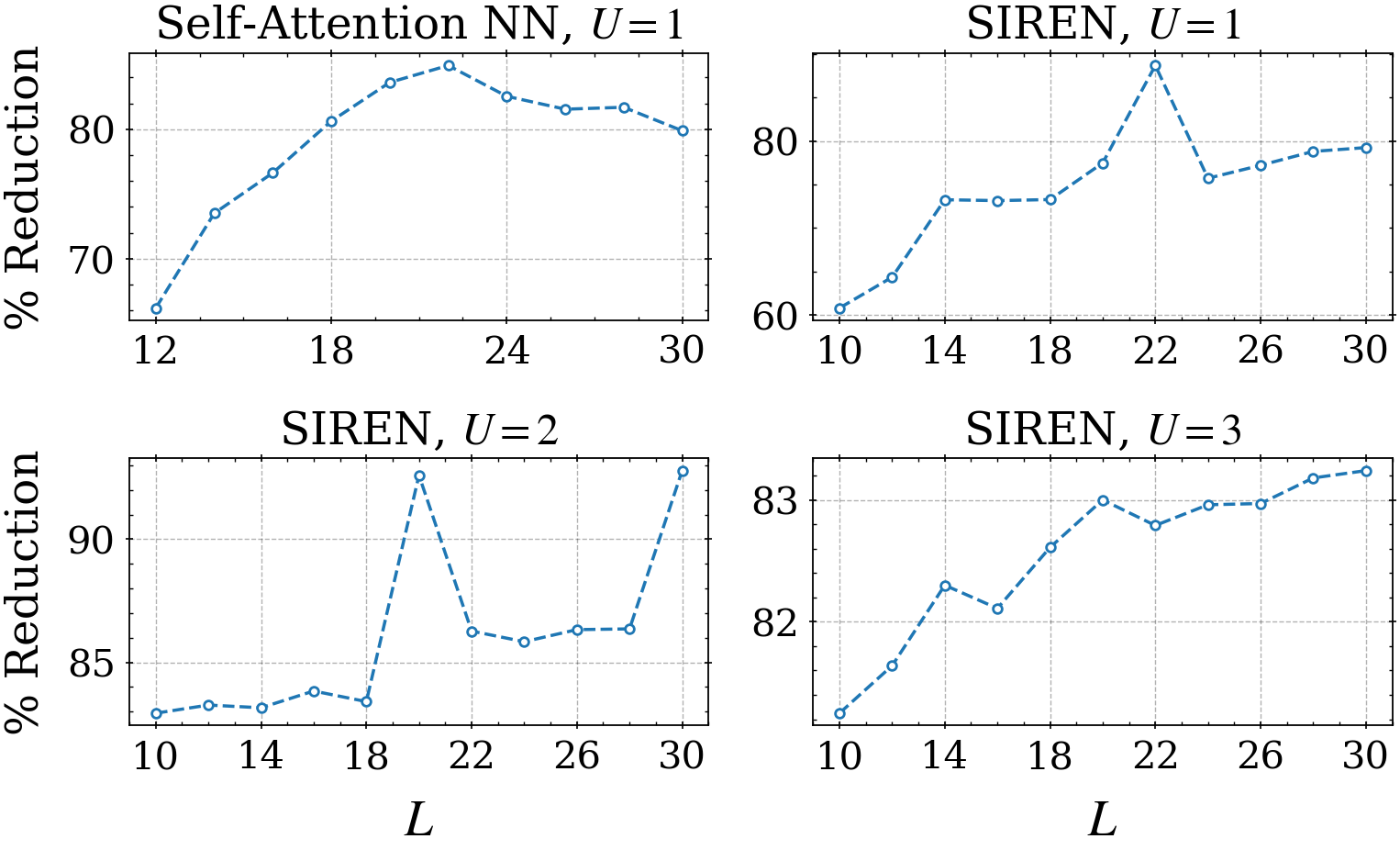
Above: Summary of results for the Hubbard model using a self-attention NN (U = 1) and SIRENs (U = 1, 2, 3) showing the percent reduction in the number of Hartree-Fock (HF) iterations as a function of the system size L. See our paper for more!